
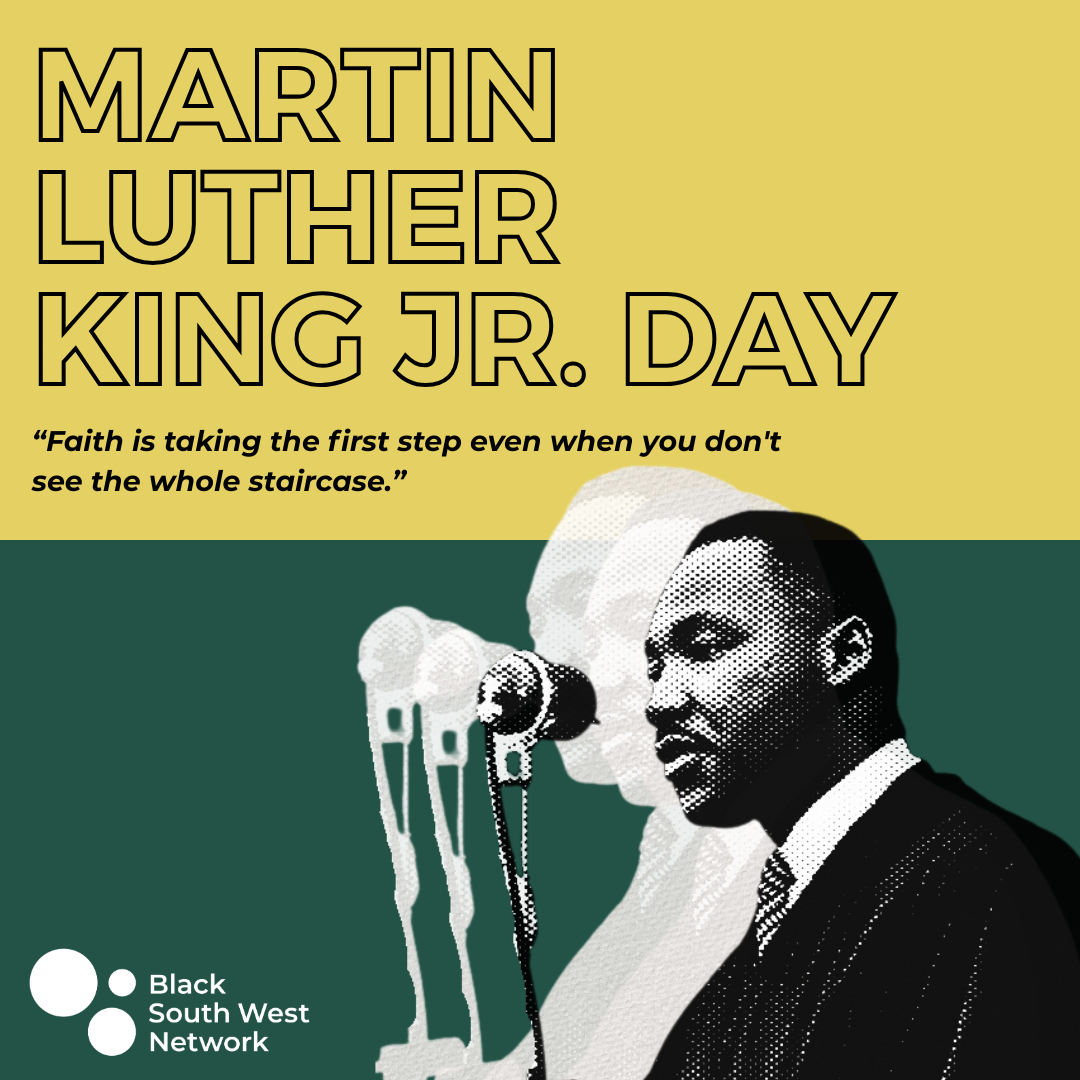
We take this moment to honour the profound impact that Reverend Martin Luther King Jr. (1929–1968) and his family have had in advancing equal rights and the fight for racial justice. Writing from his cell in a Birmingham, Alabama Jail, King shared the following words to his comrades:
“Injustice anywhere is a threat to justice everywhere. We are caught in an inescapable network of mutuality, tied in a single garment of destiny. Whatever affects one directly, affects all indirectly.” (16 April 1963)
In his time, a time only a few of us can still remember, King spoke of a shared struggle uniting Black Americans across every state and every city. Today, in an age marked by ever-tightening concentric circles of connection, his words widen in unprecedented scope – echoing across manmade borders, encompassing all oppressed peoples, and carried on digital winds.
For many of us, the sheer scale of global injustice can feel overwhelming – witnessing second-by-second moments of pain and inequity. Our ancestors were never meant to carry the weight of a world so tightly woven together. And yet, we change, we adapt, we learnt to bear it, we shape and are shaped. In time, that same awareness (as heavy as it may be) can spark something beautiful within us. Like a flint, it can ignite global movements that rise in pursuit of proper justice.
One such figure is Misan Harriman, the Nigerian-British, Oscar-nominated photographer who rose to prominence through his striking portraiture documenting social activism in action. His work captured the hearts of many, including Martin Luther King III, son of the Reverend Martin Luther King Jr., who shared Harriman’s photography of the global Black Lives Matter movement.
Black South West Network had the honour of screening Misan Harriman’s Shoot The People documentary in partnership with Watershed, which included a heartwarming interview between Harriman and King. What this showed was a genealogy of social protest, showing that the foundations of civil disobedience and community assembly built by Martin Luther King Jr. and his contemporaries continue in stride to this day.
Now more than ever, in an era shaped by photography, video-sharing, and social media, the act of documenting social struggle has become essential. Martin Luther King Jr.’s recorded speeches remain heavily referenced. Photography of the Anti-Apartheid movement played a crucial role in amassing solidarity across the globe. Mass communication platforms were the linchpin in coordinated Black Lives Matter protests in cities worldwide. And social media still plays a vital role in exposing human rights violations against oppressed communities in Gaza.
As we mark this year’s Martin Luther King Jr. Day, we are reminded that the struggle for justice has never been confined to one nation, one people, or one moment in the flow of time. It is a living, breathing, and reflexive global continuum. One that is carried forward by those who refuse to remain silent, who refuse to look away, by those who choose to document our victories and our struggles – lest we forget. From King’s resonant words in Birmingham to Harriman’s lens capturing the palpitations of modern struggles, we see how bearing witness bears fruitful action and how documentation can become a tool of resistance, a weapon or a shield.
In the spirit of photographer and anti-apartheid resistance fighter Peter Magubane, whose legacy featured in Shoot The People, let us reflect on what he said, that “a struggle without documentation is not a struggle.” May we honour this lineage by continuing to bear witness, to record, to document, to archive. To stand with those fighting for justice across the world.